Common Mistakes to Avoid in Indian Degree Attestation in Dubai
common mistakes
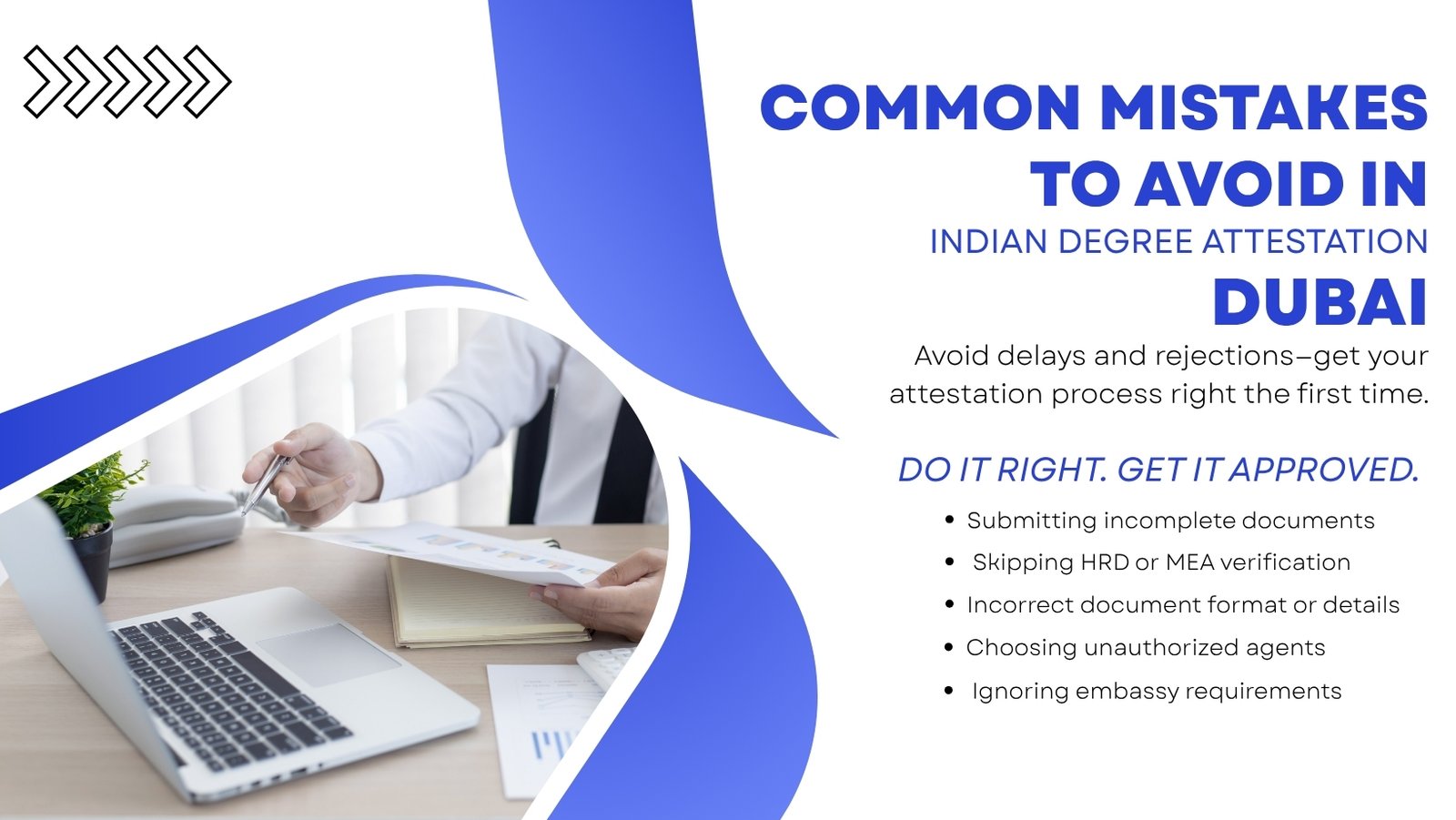
Attesting an Indian degree certificate for Dubai is one of the compulsory steps you have to take if you intend to work or study in the UAE or apply for a long-term visa. The process of Indian degree certificate attestation in Dubai includes several stages of verification, both in India and the UAE. To those who are unfamiliar, the whole process might seem like a maze, and even minor errors can cause delays or rejection of the application. Continue reading to learn about some of the common mistakes to avoid in Indian degree attestation in Dubai.
Quick Overview of the Indian Degree Attestation Process for Dubai
Before knowing the errors, it is beneficial to understand the basic procedure. In the case of Dubai and the UAE, a degree certificate from India has to be certified by multiple authorities. It firstly involves the notary attestation in India and then state HRD authentication, MEA attestation or apostille, UAE Embassy attestation, and lastly MOFA attestation in the UAE.
The whole process of Indian degree attestation in Dubai normally takes 20 to 45 days and costs around 8,000 to 20,000, depending on the level of urgency and the service providers.
Mistake 1: Submitting Incomplete or Incorrect Documents
Submitting incomplete paperwork is among the most frequent errors made by applicants. They usually forget to include mark sheets, copies of passports, or photographs. Occasionally, unclear scans or different name spellings also cause their applications to be declined. The UAE officials are very serious about the accuracy of documents. A mere difference in spelling between your educational certificate and passport is enough to cause delay or denial of the application.
The Solution
Make a checklist. Have the original degree, all mark sheets, the first and last pages of the passport, photographs, and application forms at hand. Check the names, dates, spellings, etc., thoroughly before submitting them to the authorities.
Mistake 2: Not Following the Correct Attestation Order
Degree attestation is a very orderly process. Most starters make wrong moves by either skipping steps or diving straight into MEA or embassy attestation. The result is rejection because each authority only authenticates the document if the previous level has already done so. If you leave out a single step, you break the chain, and the document is returned.
The Solution
You must always follow this order: Notary → State HRD → MEA → UAE Embassy → MOFA Dubai. Never jump steps, even if someone promises faster processing.
Mistake 3: Submitting Laminated or Damaged Degree Certificates
Degree certificates that are laminated or damaged will not be stamped properly. Lamination is not only not accepted by the UAE and Indian authorities, but it is also impossible to remove without damaging the original. In addition, documents that are torn, faded, or of poor quality will probably be suspected of being fake and may even be rejected.
The Solution
The way to solve this issue is to hand in nice, original, unlaminated degree certificates. In case your document is laminated or damaged, get a duplicate degree from your university first before you start the attestation process.
Mistake 4: Name or Detail Mismatch Across Documents
Name mismatches contribute significantly to the rejections. One such case is if your degree states “Ravi Kumar” but your passport features “Ravikumar S.” the authorities might disallow the document. Also, unsigned forms or wrong notary seals are issues that can create difficulties.
The Solution
Make sure all your documents have the exact same names as in your passport. In the case of slight differences in your name, you should get a notarised affidavit. In case of considering major changes, you may have to get a gazette notification done before you initiate your attestation.
Mistake 5: Choosing the Wrong Type of Attestation
An apostille is often thought to be the only requirement for Dubai since India signed the Hague Convention. However, to a great extent, the UAE will still require Embassy attestation and MOFA stamping for the purpose of employment and residency. Apostille only documents are commonly refused.
The Solution
Check the requirements with the UAE Embassy or MOFA. A diploma in the UAE comes with the full attestation package, including both the Embassy of the UAE and MOFA, as this is the general practice.
Mistake 6: Skipping University Verification
University verification is a must if one works in certain professions in Dubai, such as teaching, engineering, and healthcare. Several candidates disregard the step, thinking that an attestation from HRD or MEA is sufficient. Mofa may deny degrees that do not have the original institution verified.
The Solution
The way to do it is to get a letter of verification or confirmation from your university’s registrar. It might take around 10 to 15 days and cost a small fee, but it will save you from huge inconveniences later.
Mistake 7: Starting the Process Too Late
Degree attestation should never be left to the last minute. HRD departments and embassies usually encounter heavy workloads in the months leading to the peak seasons, April through June, in particular. Delaying the process may lead to missing job-joining dates or visa deadlines.
The Solution
Choose to undertake your attestation process two or three months before your planned date at the very least. In the event that you are running late, consider using the express services provided by authorised agencies. However, always try to schedule your work ahead of time.
Mistake 8: Using Unverified or Fake Agents
Many candidates succumb to the lure of agents offering “fast attestation in 3 days.” Such agents might run off with your papers or take illegal shortcuts leading to counterfeit stamps. This will be a black mark on your immigration record forever.
Solution:
Only use MEA-approved or embassy-authorised service providers like BLS or recognised PEC centres. Moreover, always demand receipts, tracking IDs, and official contact details.
Mistake 9: Ignoring Degree Validity or Supporting Proofs
Some candidates upload certificates issued for a certain time only, documents that have expired, or transcripts that are no longer valid and do not provide any evidence to back them up. The UAE authorities could raise the issue of the authenticity of such degrees, particularly if they were obtained many years ago.
The Solution
Complete and final degree certificates should be the ones that you submit.
In case you don’t have the original, get a provisional certificate with convocation proof or university confirmation letters.
The Bottom Line
These are some of the most common mistakes, and this is how you should address these mistakes as well. Greenline Attestation Services brings you a dependable, expert and thoroughly managed attestation service which is trusted by expats, professionals and businesses throughout the UAE. You may rely on us, as we are one of the top Indian degree certificate attestation services in Dubai.
Located in Dubai and having the support of more than 35 years of experience in the industry, Greenline Attestation is a major player in the field of Indian degree certificate attestation for UAE employment, work visas, family visas, freelance permits, and higher studies. The process from initial verification in India to the final MOFA stamp in the UAE is taken care of with precision and safety at every stage.
Fact Checked & Reviewed By
Santhosh K Nair
Founder & CEO of Greenline Attestation Services | 12+ years of core experience in document legalization, MOFA attestation, and embassy procedures in the UAE.