Why Do Universities Ask for Attested Transcripts? What Students Should Know
attestation services in dubai
When students apply to universities, colleges, professional programs, or international institutions, they may be asked to submit more than a degree or diploma certificate. In some situations, the institution may also request an academic transcript and may specify that the document must be authenticated or attested.
For students unfamiliar with international documentation, this can be confusing. If a transcript already contains their academic records, why does it need additional verification?
The answer depends on the university, country, course, and purpose of the application. Understanding the role of transcripts can help students prepare their documents correctly and avoid unnecessary delays.
What Is an Academic Transcript?
An academic transcript is a record of a student’s academic history.
Unlike a degree certificate, which generally confirms that a qualification was awarded, a transcript provides more detailed information about the student’s studies.
Depending on the institution, it may include:
- Subjects or courses studied
- Grades or marks
- Credits
- Examination results
- Academic years or semesters
- Program information
- Date of completion
- Institutional details
A university may request a transcript because it wants to understand the student’s academic record rather than simply confirm that a qualification exists.
Why Would a University Ask for an Attested Transcript?
Universities receive applications from students educated in different countries and under different education systems. This can make document verification an important part of the admissions process.
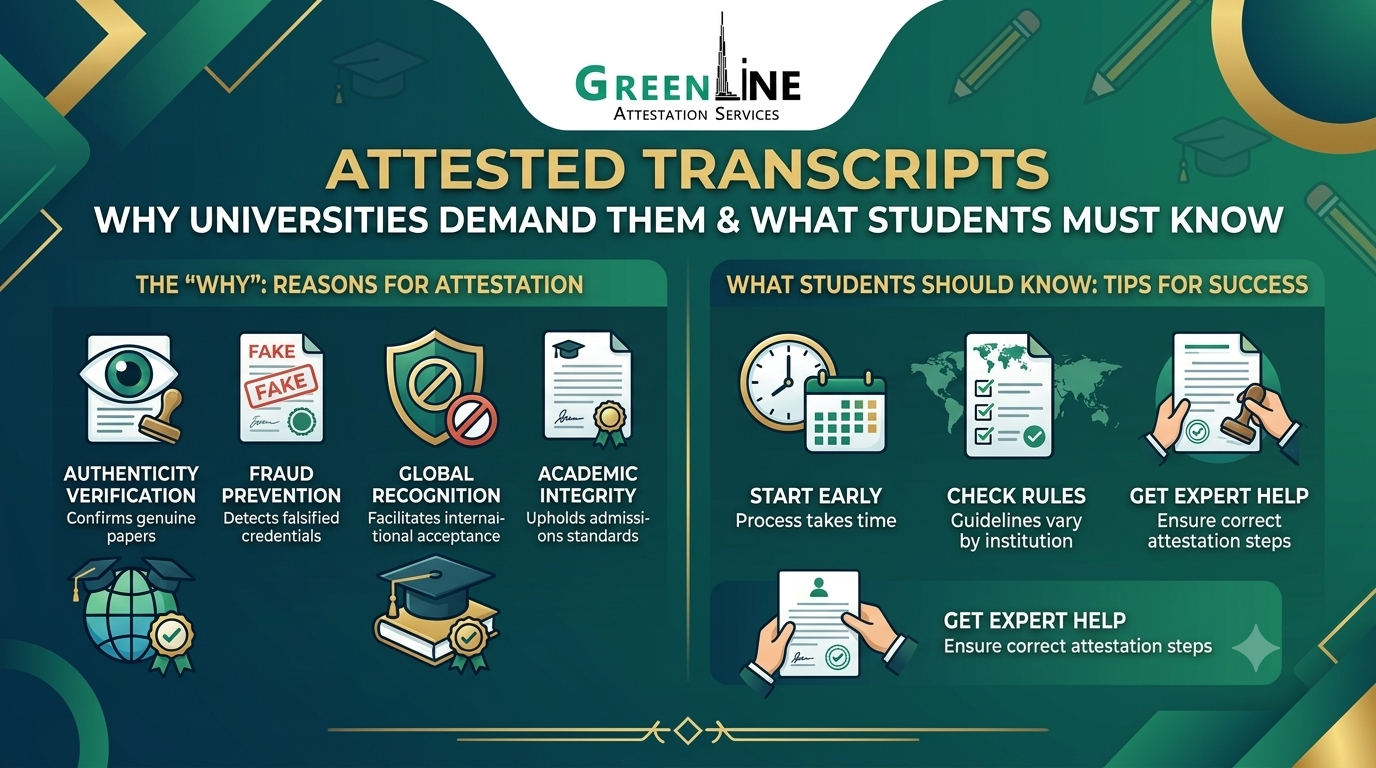
An institution may request an authenticated or attested transcript to establish greater confidence in the origin and validity of the academic record.
This does not necessarily mean that the university suspects the student of submitting a false document. Verification can simply be part of the institution’s standard procedure for international applicants.
For students arranging certificate attestation in Dubai, it is therefore important to determine exactly which academic documents the receiving institution requires.
A Degree Certificate and Transcript Serve Different Purposes
One of the most common misunderstandings is treating a degree certificate and transcript as interchangeable documents.
They are not.
A degree certificate generally demonstrates that a qualification has been awarded.
A transcript provides a detailed academic record showing what the student studied and how they performed.
For example, two students may hold degrees with the same title, but their transcripts can show different subjects, credits, grades, or study periods.
A university evaluating an applicant may therefore need both documents.
Why International Universities May Need More Verification
An institution reviewing an international qualification may not be familiar with the issuing country’s education system.
It may need to establish:
- Whether the institution is genuine
- Whether the student attended the institution
- Whether the academic record belongs to the applicant
- Whether the qualification was actually awarded
- Whether the academic record meets admission requirements
- Whether the document has been issued by the appropriate authority
Depending on the institution’s policies, this may involve direct verification with the issuing institution or additional document authentication.
Does Every University Require Attested Transcripts?
No.
There is no universal rule requiring every university to request an attested transcript from every applicant.
Requirements can differ based on:
- University
- Country
- Program
- Student’s previous education
- Qualification type
- Application purpose
- Immigration or regulatory requirements
Some institutions may accept digital academic records or documents submitted directly by the issuing institution. Others may require authenticated copies or attested documents.
Students should therefore follow the document checklist provided by the specific institution rather than assuming that another university’s requirements will apply.
What If Your University Requests an Attested Transcript?
The first step is to clarify exactly what the university means by “attested.”
The term can sometimes be used broadly, while the actual requirement may involve authentication, legalization, certification, or another form of document verification.
Before processing the transcript, ask the university or admissions department:
- Does the transcript need to be attested?
- Is the original transcript required?
- Is a certified copy acceptable?
- Does the document need translation?
- Which authorities must authenticate it?
- Does the university require direct verification from the issuing institution?
- Are there country-specific requirements?
Getting these answers before processing can prevent students from spending time and money on an incorrect document procedure.
What Happens If the Transcript Is in Another Language?
Language can create an additional documentation requirement.
If a transcript is issued in a language that the receiving university does not accept, the institution may request a translation.
Students looking for legal translation services in Dubai should first confirm whether translation is required and whether the university has specified any particular translation standard.
Translation and attestation are separate processes.
A translated document does not automatically become an authenticated document, and an attested document does not automatically satisfy a translation requirement.
In some cases, both may be necessary.
What If the Transcript and Degree Certificate Have Different Details?
Students should carefully compare their academic documents before submitting them.
Check details such as:
- Full name
- Date of birth, where included
- Institution name
- Course or program name
- Enrollment period
- Graduation or completion date
- Registration or student number
Minor differences can sometimes create questions during verification.
For example, if a student’s name appears differently on their passport and academic documents, the receiving institution may request additional clarification.
Identifying discrepancies before submission gives the student an opportunity to address them rather than discovering the problem after the documents are already being processed.
Can an Attested Transcript Guarantee Admission?
No.
Document attestation and university admission are separate matters.
Attestation may help establish the authenticity or legal status of a document for its intended use, but it does not guarantee that a university will accept the qualification or admit the applicant.
Universities can have their own academic requirements, eligibility criteria, entrance requirements, and document-review procedures.
Students should therefore treat attestation as a documentation requirement rather than an admission guarantee.
What About Qualification Equivalency?
Another important distinction is between document attestation and qualification equivalency.
A university or authority may ask whether a foreign qualification is equivalent to a particular local qualification.
This is different from simply authenticating the certificate or transcript.
Students should confirm whether they need:
- Certificate attestation
- Transcript authentication
- Qualification evaluation
- Equivalency
- Translation
- Direct university verification
Understanding the difference can prevent students from arranging a service that does not satisfy the actual requirement.
Preparing Your Transcript Before Attestation
Before submitting an academic transcript for processing, students should make a simple checklist.
Verify the document
Make sure the transcript is complete, legible, and issued by the appropriate institution.
Check personal information
Ensure the name and other identifying information are consistent with supporting documents.
Confirm the university’s requirements
Do not assume that every university requires the same type of authentication.
Check translation requirements
Find out whether the receiving institution accepts the transcript in its original language.
Confirm whether an original is necessary
Some institutions may accept certified copies or documents sent directly by the issuing institution.
Keep copies
Maintain digital and physical copies of important academic documents before submitting originals.
Where Professional Assistance Can Help
Students dealing with international documentation may find the process difficult when several authorities or requirements are involved.
A professional certificate attestation service in Dubai can help applicants understand the applicable documentation process based on the document type, country of issuance, and intended use.
This can be particularly useful for students who have completed their education outside the UAE and need to prepare academic documents for a university or other institution.
However, students should always confirm the receiving university’s requirements first. The service provider can help with the applicable document process, but the university determines what it will accept for admission or academic purposes.
Green Line Attestation Services
Green Line Attestation Services assists students and other applicants with document attestation requirements in Dubai and the UAE.
Depending on the circumstances, assistance may be available for academic certificates, transcripts, personal documents, and related documentation requirements.
Students preparing documents for an international university should provide the institution’s document instructions before beginning the process. This helps establish whether the requirement concerns attestation, authentication, translation, certification, or another form of verification.
Final Thoughts
An academic transcript provides much more detail about a student’s education than a degree certificate alone. For this reason, universities may request transcripts when assessing international applications or verifying academic history.
However, not every university requires an attested transcript, and the exact requirements can vary significantly.
If a university specifically asks for an authenticated or attested transcript, students should first clarify what type of document processing it expects. They should also check whether translation, direct institutional verification, certification, or qualification evaluation is required.
For students preparing certificate attestation in Dubai, understanding the university’s requirements before submitting documents is one of the most important steps.
A little preparation can help ensure that the transcript submitted is the right document, in the right format, with the right verification.
Fact Checked & Reviewed By
Santhosh K Nair
Founder & CEO of Greenline Attestation Services | 12+ years of core experience in document legalization, MOFA attestation, and embassy procedures in the UAE.