Why Does the Same Degree Require Different Documents in Different Countries?
legal translation services in Dubai
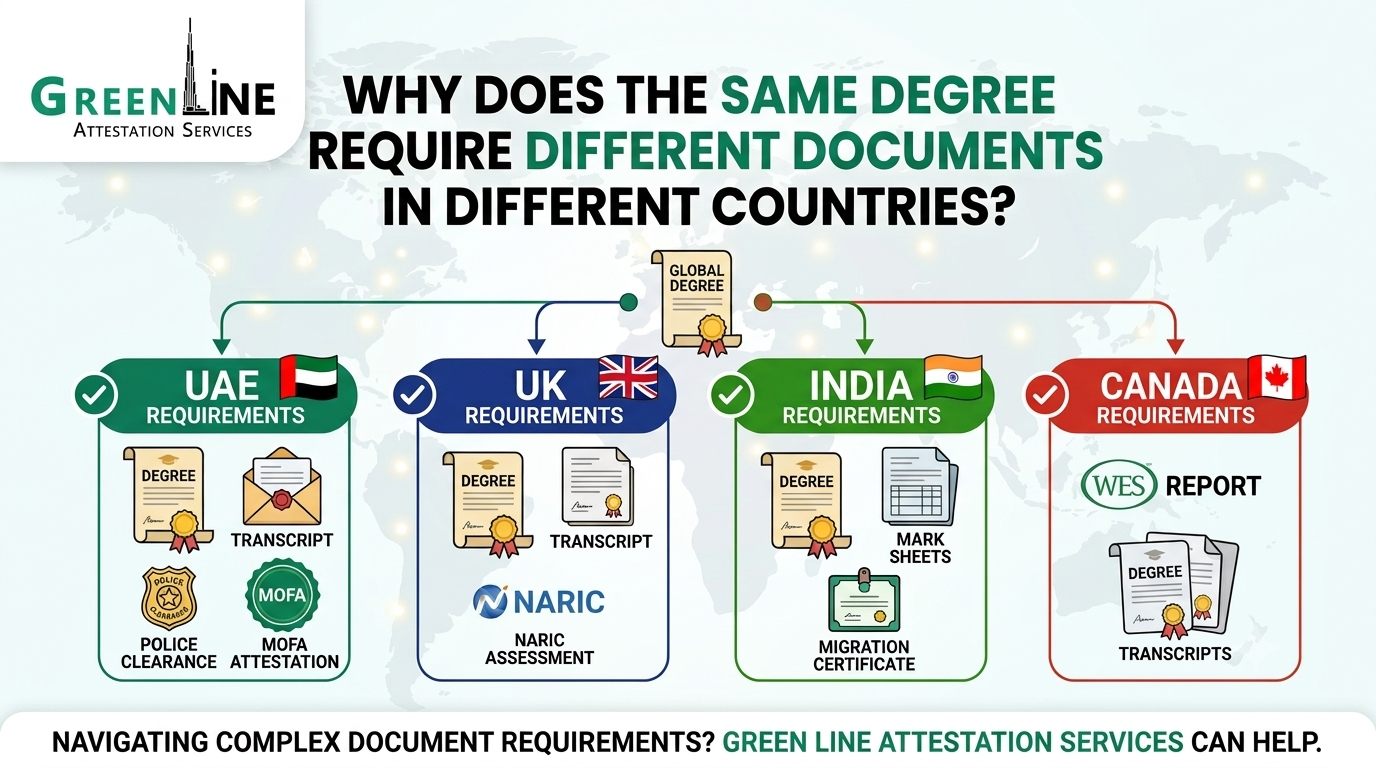
A degree certificate may be issued by the same university, belong to the same student, and represent the same qualification, yet the documents required for using that degree abroad can vary from one country to another.
This often surprises graduates who assume that once their degree is valid in their home country, it can be submitted internationally without any additional documentation.
In practice, employers, universities, government departments, licensing bodies, and immigration authorities may have different requirements for foreign educational qualifications. Depending on the destination and purpose, an applicant may be asked for a degree certificate, academic transcript, verification, authentication, attestation, translation, or additional qualification-related documents.
Understanding this difference before sending your documents can help prevent delays and unnecessary processing.
Why Do Countries Have Different Document Requirements?
There is no single international system for accepting educational documents.
Each country has its own administrative procedures, education system, immigration framework, and rules for accepting foreign-issued documents.
When a foreign degree is submitted, the receiving organization may need to establish several things:
- Whether the document is genuine
- Whether the issuing institution is recognized
- Whether the applicant actually completed the qualification
- Whether the document belongs to the person submitting it
- Whether the qualification meets the requirements of the intended purpose
- Whether the document has been properly authenticated for use in that country
As a result, the same degree may require different supporting documents depending on where it is going to be used.
A Degree Certificate Is Not the Same as an Academic Transcript
One of the most important distinctions students and professionals should understand is the difference between a degree certificate and a transcript.
A degree certificate generally confirms that a qualification was awarded.
An academic transcript provides more detailed information about the student’s academic record, such as subjects, grades, credits, semesters, and other course information.
One country or institution may ask only for the degree certificate, while another may require both the certificate and transcript.
For example, an employer may want evidence that a qualification was awarded, while an educational institution may need detailed academic information to assess admission or transfer eligibility.
This is why applicants should not assume that their degree certificate alone will satisfy every international documentation requirement.
The Purpose of the Document Changes the Requirement
The destination country is important, but the purpose of the document is equally important.
A foreign degree may be required for:
- Employment
- Higher education
- Professional licensing
- Immigration
- Government applications
- Qualification recognition
- Salary or professional classification
- Regulatory registration
The documentation required for an employment application may therefore be different from the documents required for university admission or professional licensing.
Before arranging document processing, determine exactly where and why the degree will be submitted.
Why Attestation May Be Required
When a foreign-issued educational document is being used internationally, the receiving authority may require authentication or legalization to establish its validity for official use.
For applicants preparing certificate attestation in Dubai, the applicable process can depend on the country where the degree was issued, the type of document, and its intended purpose.
Attestation should not be viewed as a universal procedure that is identical for every country.
The appropriate authentication or legalization route can differ according to the document’s origin and destination.
Country of Origin Can Change the Process
Consider two graduates who are moving to Dubai.
One has a degree issued in India, while the other has a degree issued in another country.
Although both applicants may have bachelor’s degrees, their certificates may follow different authentication procedures because the documents originate from different education and administrative systems.
This is one reason Indian certificate attestation in Dubai is treated as a specific document-processing requirement rather than simply applying one generic process to every foreign certificate.
The issuing country’s procedures, competent authorities, and document format can all influence what needs to happen before the certificate can be used in the UAE.
Why Employers May Request Additional Documents
Employers sometimes request educational documents beyond a degree certificate.
They may ask for:
- Degree certificate
- Academic transcript
- Professional certificate
- Experience documents
- Qualification verification
- Attested educational documents
The reason can vary depending on the position, employer, profession, and applicable regulatory requirements.
For regulated professions, additional documentation may be particularly important because the organization may need to establish that the applicant’s qualification meets specific professional requirements.
Applicants should therefore distinguish between document authenticity and professional eligibility.
Having an authentic degree does not automatically mean that the qualification satisfies every licensing or employment requirement.
Why Universities May Ask for Transcripts
Universities often need more detailed academic information when evaluating international students.
A degree certificate may tell an institution that a student completed a particular program, but a transcript can show:
- Individual subjects
- Marks or grades
- Credit hours
- Academic performance
- Study duration
- Semester information
This information can help an institution assess whether previous studies meet its admission or transfer requirements.
Consequently, students applying internationally should not be surprised if a university asks for both documents.
Translation Can Also Change the Requirements
Language is another reason why the documentation process can differ between countries.
A degree issued in one language may need to be translated before it can be submitted to a particular authority.
Applicants should confirm:
- Whether translation is required
- Which language is accepted
- Whether a particular type of translation is required
- Whether the translated document must also be authenticated or certified
People who require legal translation services in Dubai should establish these requirements before arranging the translation.
Translation and attestation are separate processes, so completing one does not automatically satisfy the other.
What About Equivalency?
Another common source of confusion is qualification equivalency.
A person may have an authentic and properly attested degree but still be asked to obtain qualification recognition or equivalency for a particular purpose.
These processes address different questions.
Attestation generally concerns the authentication or legalization of the document.
Equivalency or qualification recognition concerns whether the qualification meets the relevant academic or regulatory criteria.
Therefore, applicants should carefully read the request made by the employer, university, licensing authority, or government department.
If the requirement says “equivalency,” arranging only certificate attestation may not be sufficient.
Why Requirements Can Change Over Time
Documentation requirements are not necessarily permanent.
Authorities can update procedures, introduce digital verification systems, change application platforms, or modify document requirements.
Universities and employers can also update their internal policies.
For this reason, an applicant should not rely solely on an old checklist provided to another person.
A process that applied several years ago may not be identical to the current procedure.
What Should You Check Before Sending Your Degree?
Before submitting your original certificate for processing, use this checklist.
1. Identify the destination country
Where will the degree actually be used?
2. Identify the receiving authority
Is it an employer, university, government department, licensing body, or another organization?
3. Confirm the required documents
Determine whether they need a degree certificate, transcript, or additional records.
4. Check authentication requirements
Find out whether authentication, legalization, attestation, or another verification process is required.
5. Check language requirements
Determine whether the original document is accepted or whether translation is necessary.
6. Check whether qualification recognition is separate
If the organization asks for equivalency or recognition, don’t assume attestation satisfies that requirement.
7. Keep copies of your documents
Before submitting original certificates, keep clear digital and physical copies for your records.
Why Professional Attestation Assistance Can Be Useful
International document processing can become complicated when a certificate passes through multiple authorities or when the applicant is unfamiliar with the requirements of the destination country.
A professional attestation provider can help applicants identify the relevant document-processing stages based on the certificate’s country of origin and intended use.
This can be particularly useful for graduates who have completed their education outside the UAE and now need to prepare their qualifications for employment, education, immigration, or another official purpose.
However, applicants should always confirm the requirements of the receiving organization. A service provider can assist with document processing, but the final receiving authority determines what documents it accepts.
Green Line Attestation Services
Green Line Attestation Services assists individuals, students, professionals, and families with document-related requirements in Dubai and the UAE.
The applicable service can vary according to the document, country of origin, and intended use. Educational certificates may require different processing from personal or commercial documents.
If you are preparing a foreign degree for use in Dubai, provide the document details and the requirements given by the receiving organization before beginning the process. This makes it easier to identify whether you need attestation, authentication, translation, verification, or another form of document processing.
Final Thoughts
A degree does not automatically follow the same documentation process in every country.
The requirements can change because countries have different administrative systems, receiving authorities have different objectives, and educational documents may be used for different purposes.
A graduate moving to Dubai for employment may face different requirements from a student applying to a university or a professional seeking regulatory recognition.
Therefore, the safest approach is to identify the destination, purpose, receiving authority, document type, and required verification before processing your certificate.
If you are arranging certificate attestation in Dubai, don’t simply ask, “How do I attest my degree?” Instead, establish why the degree is being submitted and what the receiving authority specifically requires.
That small distinction can help you avoid processing the wrong document, arranging unnecessary services, or discovering an additional requirement after the process has already started.
Fact Checked & Reviewed By
Santhosh K Nair
Founder & CEO of Greenline Attestation Services | 12+ years of core experience in document legalization, MOFA attestation, and embassy procedures in the UAE.