Philippines CENOMAR & Marriage Certificate Attestation for UAE Family Visa
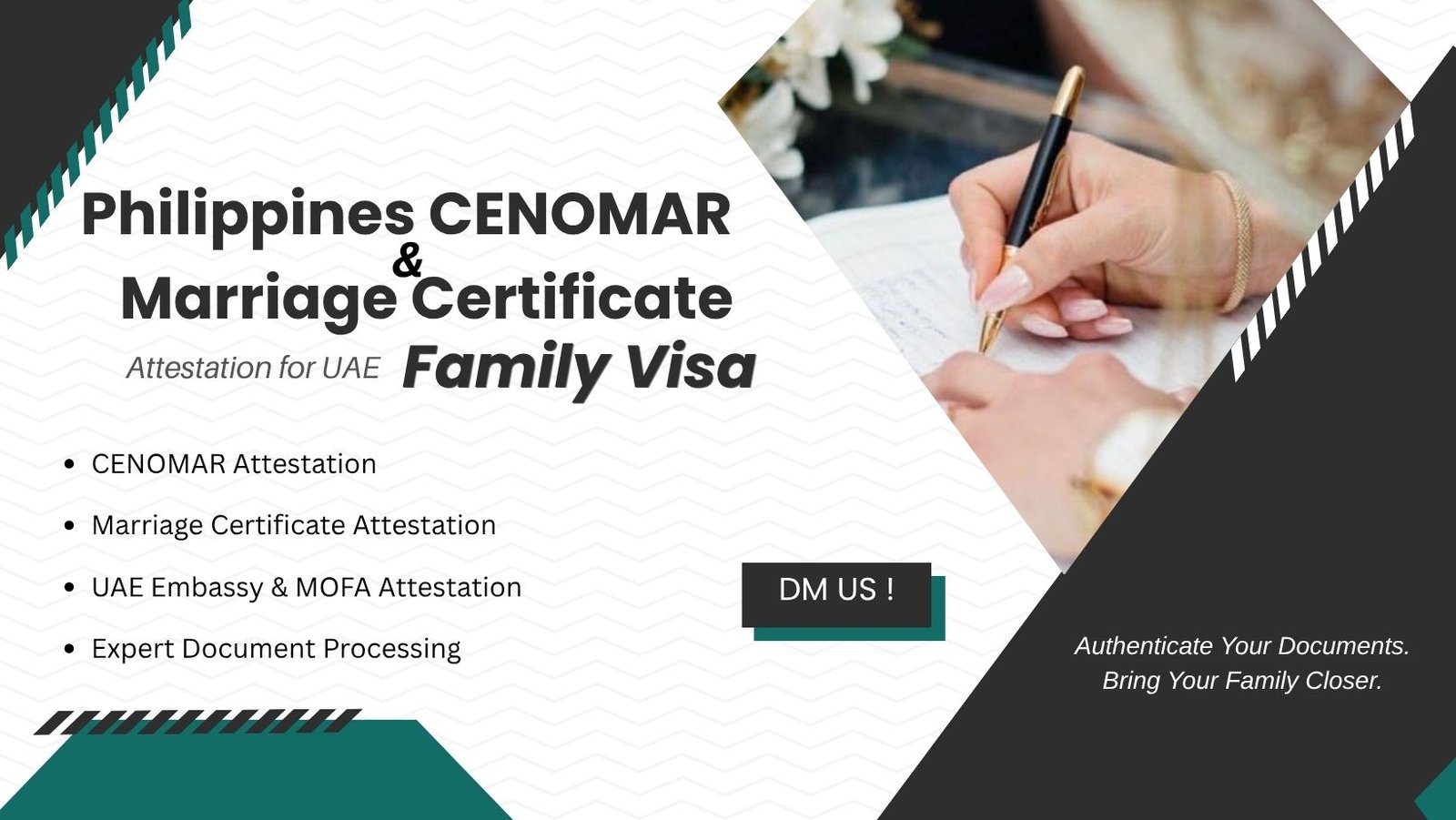
Philippines CENOMAR & Marriage Certificate Attestation for UAE Family Visa
If you’re a Filipino expat in the UAE planning to sponsor your spouse or children on a family visa, two documents will make or break your application: your CENOMAR (Certificate of No Marriage Record) and your PSA Marriage Certificate. Both need to go through a specific attestation and apostille process before GDRFA, ICP, or any UAE typing center will accept them.
This guide walks you through exactly what CENOMAR is, why UAE authorities ask for it even after you’re already married, the full attestation chain from Manila to Dubai, costs, processing time, and the mistakes that cause the most rejections among Filipino applicants.
What Is a CENOMAR and Why Does UAE Family Visa Need It?
CENOMAR (Certificate of No Marriage Record) is a document issued by the Philippine Statistics Authority (PSA) that certifies whether a person has any marriage record on file in the Philippines.
Here’s the part that confuses most applicants: if you’re already married, why would you need a document proving you have “no marriage record”?
UAE immigration doesn’t use CENOMAR to prove you’re single — they use it as a cross-verification document. When you submit your Marriage Certificate for a spouse or dependent visa, UAE authorities often also request a CENOMAR dated close to your marriage date to confirm that:
- Neither spouse had a prior undissolved marriage on record at the time of the wedding
- The marriage being submitted is the only legally recognized marriage for both parties
- There’s no conflicting civil registry data that could flag the file for fraud review
In short: your Marriage Certificate proves the marriage happened, and your CENOMAR proves it was legally valid to happen — no bigamy, no unresolved prior marriage. Immigration officers in the UAE see this combination often enough that it’s become close to a standard requirement for Filipino spouse visa and family sponsorship applications.
Documents You’ll Need for a Filipino Family Visa Attestation
| Document | Issued By | Required For |
|---|---|---|
| PSA Marriage Certificate | Philippine Statistics Authority | Spouse visa, family sponsorship |
| CENOMAR (Certificate of No Marriage Record) | Philippine Statistics Authority | Cross-verification of marital status |
| PSA Birth Certificate (for children) | Philippine Statistics Authority | Children’s dependent visas |
| CENOMAR of children (if applicable) | PSA | Sometimes requested for adult dependents |
| Valid Passport copies | DFA / Philippine Government | All family members |
The Full CENOMAR & Marriage Certificate Attestation Process
Unlike countries that are part of the Hague Apostille Convention, the Philippines has its own Apostille system since 2019, which replaced the older embassy authentication process for most countries — but the UAE requires a different route, since it is not a party to the Hague Apostille Convention in the same way. This is the single biggest point of confusion for Filipino applicants, so read this section carefully.
Step 1: Request PSA-Issued Documents
Order your CENOMAR and Marriage Certificate directly from PSA (PSA Serbilis or PSAHelpline.ph). Always request the PSA Security Paper (SECPA) version — UAE authorities will not accept plain photocopies or LCR (Local Civil Registry) copies.
Keyword tip for your search: “PSA CENOMAR online order,” “PSA marriage certificate SECPA copy,” “how to get CENOMAR Philippines”
Step 2: DFA Authentication (Red Ribbon / Apostille)
Because the UAE is not a Hague Apostille member for document acceptance purposes in most attestation workflows, your PSA documents typically still need to go through the Department of Foreign Affairs (DFA) authentication process — commonly known by its older name, “Red Ribbon,” even though the physical red ribbon has been phased out in favor of a QR-coded certification.
You can process this at DFA Aseana, DFA regional consular offices, or through DFA’s online appointment system.
Step 3: UAE Embassy Attestation in the Philippines
After DFA authentication, the document must be legalized by the UAE Embassy in Manila. This step confirms the document is recognized as valid for use specifically in the United Arab Emirates.
Step 4: MOFA Attestation in the UAE
The final step happens after you’ve physically brought (or couriered) the document to the UAE. The UAE Ministry of Foreign Affairs (MOFA) stamps the document, making it officially valid for submission to GDRFA, ICP, typing centers, schools, or employers.
Only after MOFA attestation is complete can the document be used for your family visa application.
Attestation Chain Summary (Philippines → UAE)
- PSA (issue CENOMAR / Marriage Certificate — SECPA copy)
- DFA Authentication (Manila or regional DFA office)
- UAE Embassy Attestation (Manila)
- MOFA Attestation (UAE)
Missing any single step in this chain will result in an incomplete file — GDRFA and ICP typing centers check for the full stamp sequence, not just the final one.
How Long Does CENOMAR Attestation Take?
Processing time varies depending on where you start:
- PSA document issuance: 3–10 working days (faster with PSA Serbilis courier service)
- DFA authentication: 1–7 working days depending on the office and whether you use expedited processing
- UAE Embassy attestation (Manila): 3–5 working days
- MOFA attestation (UAE): Typically 1–3 working days once the document is with an authorized attestation service
Total realistic timeline: 2–4 weeks if everything is done back-to-back without delays. This is why most Filipino families sponsoring a spouse or children start the attestation process well before submitting the actual GDRFA or ICP visa application.
Common Mistakes Filipino Applicants Make
- Ordering an old CENOMAR — some UAE typing centers and embassies want a CENOMAR issued within 3–6 months of application; an outdated copy can be rejected.
- Using an LCR copy instead of PSA SECPA copy — locally issued civil registry copies are not accepted for UAE attestation.
- Skipping DFA authentication and going straight to the UAE Embassy — the UAE Embassy in Manila will not accept a document without prior DFA authentication.
- Forgetting the CENOMAR entirely — many applicants only submit the Marriage Certificate, then get a request for CENOMAR later, adding weeks to their visa timeline.
- Name discrepancies between the PSA Marriage Certificate, CENOMAR, and passport (common with maiden names, middle names, or suffixes) — these need to be resolved with an affidavit before attestation, not after.
- Assuming Apostille alone is enough — since the UAE handles this differently from most Hague member countries, applicants who stop at the Apostille stage often find their documents rejected by GDRFA or ICP.
FAQs: CENOMAR & Marriage Attestation for UAE Visa
Do both spouses need a CENOMAR, or just one?
Typically, both spouses’ CENOMARs are requested if both are Filipino, since the document confirms both parties’ marital history at the time of the wedding.
Is CENOMAR required if we’ve been married for many years?
Yes — the date on the CENOMAR usually needs to reflect status around the marriage date, not your current date, so even long-married couples are often asked for it during family visa processing.
Can I get my documents attested while I’m already in the UAE?
The PSA, DFA, and UAE Embassy steps must be completed in the Philippines (in person or through an authorized representative/courier service). Only the final MOFA step happens in the UAE — which is where a local attestation service becomes essential if you can’t travel back yourself.
What if my Marriage Certificate has an annotation (e.g., due to a legal correction)?
Annotated PSA certificates can still be attested, but they may face additional scrutiny and sometimes require supporting legal documents. It’s best to flag this upfront with your attestation service provider.
Skip the Back-and-Forth — Let Green Line Attestation Handle It
Coordinating PSA orders, DFA authentication, UAE Embassy legalization in Manila, and MOFA attestation in Dubai — often across two countries and multiple time zones — is exactly the kind of process that eats weeks of your time if you handle it alone.
At Green Line Attestation Services, we manage the entire CENOMAR and Marriage Certificate attestation chain for Filipino families sponsoring spouses and children on UAE family visas — from coordinating your PSA and DFA steps in the Philippines to the final MOFA stamp here in the UAE. We pick up and deliver documents anywhere across the Emirates, and we’ll tell you upfront exactly which documents your specific visa case needs, so you’re not caught off guard mid-application.
Planning to sponsor your spouse or children this year? Get in touch with our team for a free, no-obligation document checklist tailored to your family visa case.
Fact Checked & Reviewed By
Santhosh K Nair
Founder & CEO of Greenline Attestation Services | 12+ years of core experience in document legalization, MOFA attestation, and embassy procedures in the UAE.