Sponsoring Your Parents on a UAE Family Visa: Which Documents Need Attestation?
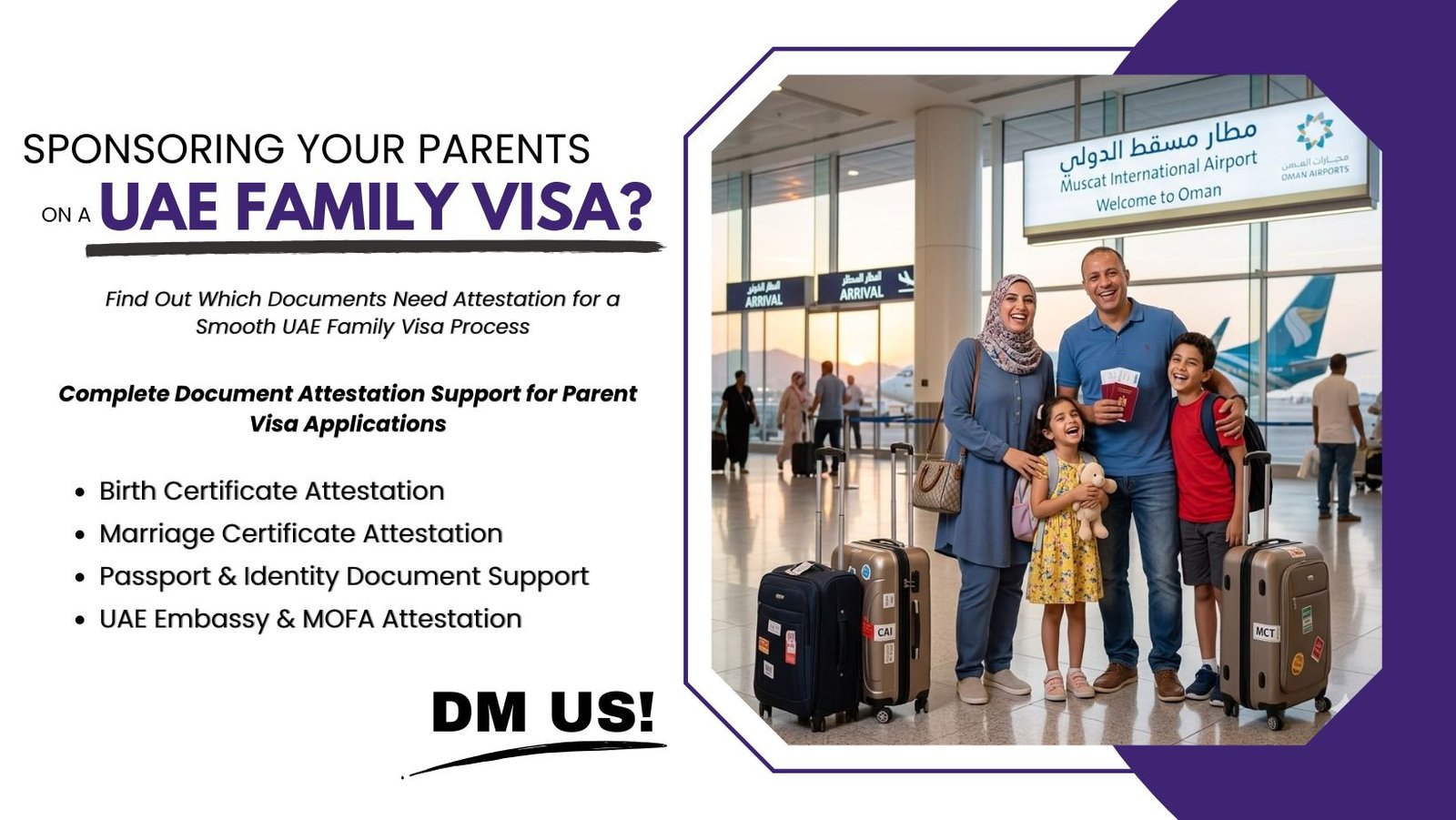
family Attestation in Dubai
Bringing your parents to live with you in the UAE is one of the most rewarding steps in settling into life here — but it also comes with one of the strictest paperwork trails of any visa category. Immigration authorities need airtight proof of who your parents are, how they’re related to you, and that your income can support them. That proof has to come in the form of attested documents, or your application simply won’t move forward.
If you’re planning to sponsor your mother, father, or both parents on a UAE residence visa, here’s exactly which documents need attestation, why each one matters, and how to avoid the delays that trip up most first-time applicants.
Why Attestation Matters for Parent Sponsorship
A birth certificate or marriage certificate issued in India, the Philippines, Pakistan, the UK, or anywhere else in the world has no automatic legal standing in the UAE. Before immigration authorities, typing centers, or the General Directorate of Residency and Foreigners Affairs (GDRFA) will accept it, the document must pass through an official chain of verification — starting in your home country and ending with the UAE Ministry of Foreign Affairs (MOFA).
For parent sponsorship specifically, this matters more than almost any other visa category, because the entire application hinges on proving a genuine parent-child relationship. Any inconsistency, missing stamp, or unattested certificate can result in rejection, extra scrutiny, or having to restart the process.
The Core Documents That Need Attestation
1. Your Birth Certificate
This is the single most important document in a parent sponsorship case. It establishes the legal link between you and the parent you’re sponsoring, and it must go through the full attestation chain: notary or home-country ministry, UAE Embassy in your home country, and finally MOFA attestation in UAE.
If your name on the birth certificate differs even slightly from your passport or Emirates ID (a common issue with transliterated names), you’ll likely also need a name-change or affidavit document attested to bridge the gap.
2. Your Parents’ Marriage Certificate
Since you’re sponsoring both parents (or proving the family relationship as a unit), their marriage certificate typically needs attestation as well. This confirms the legal relationship between your mother and father, which authorities cross-reference against your birth certificate.
3. Your Parents’ Passports and Passport Copies
While passports themselves aren’t “attested” in the traditional sense, GDRFA will require attested copies or notarized true copies in some cases, particularly if there are discrepancies in spelling or dates across other documents.
4. Your Educational or Employment-Related Certificates
As the sponsor, your degree certificate attestation may already be on file from your own employment visa — but if it isn’t, or if it’s expired due to a job change, you may need to re-attest it, since your ability to sponsor is directly tied to your salary and job title, both of which are validated against your qualifications.
5. No Objection Certificate (NOC) or Salary Certificate
This isn’t attested in the same way as a civil document, but it must be issued and stamped by your employer, and in many cases, notarized to confirm authenticity for the immigration file.
6. Divorce or Death Certificates (If Applicable)
If one of your parents is deceased or your parents are divorced, and you’re sponsoring only one of them, you’ll need the relevant death certificate or divorce decree attested through the same chain — notary, home-country ministry, UAE Embassy, and MOFA.
The Attestation Chain, Step by Step
Every civil document for parent sponsorship generally follows this sequence:
- Notary Attestation (Home Country) — Initial verification at the local or state level.
- Home Country Ministry Attestation — Authentication by the relevant government department (e.g., Ministry of External Affairs in India, HRD for educational documents).
- UAE Embassy Attestation (Home Country) — Legalization by the UAE Embassy or Consulate in the country where the document was issued.
- MOFA Attestation (Dubai/UAE) — The final stamp that makes the document legally valid for use inside the UAE.
Skipping or misordering any of these steps is one of the most common reasons parent sponsorship applications get delayed or rejected.
Common Mistakes That Delay Parent Visa Applications
- Using a laminated original certificate — many home-country authorities won’t attest a laminated document, and removing lamination can damage it.
- Mismatched names across the birth certificate, marriage certificate, and passport due to transliteration differences.
- Submitting an old attestation on a certificate that was reissued or replaced, without re-attesting the new copy.
- Forgetting translation — if your parents’ documents aren’t in English or Arabic, they’ll need certified legal translation in addition to attestation.
- Assuming apostille is enough — apostille only works for Hague Convention countries. If your parents’ documents are from a non-Hague country, full attestation (not apostille) is required for UAE use.
How Long Should You Budget for This?
Because parent sponsorship typically requires attesting multiple documents at once — often from more than one country if your parents’ certificates were issued at different times or locations — the timeline can stretch longer than a standard single-certificate attestation. Starting the attestation process well before you plan to apply for the visa gives you a buffer against unexpected embassy delays or document corrections.
Let Us Handle the Paperwork
Parent sponsorship is emotional enough without also chasing notaries, ministries, and embassies across two countries. At Green Line Attestation Services, we manage the entire attestation chain — from your home country’s notary all the way through UAE MOFA — for birth certificates, marriage certificates, and every supporting document your parent visa application needs.
We collect your original documents from your doorstep anywhere in the UAE, track them at every stage, and deliver them back safely once fully attested. If you’re planning to bring your parents to the UAE, get in touch with us before you begin your GDRFA application — it’s the easiest way to avoid a rejected file and a lost fee.
For more information, please visit our page: Family visa services in Dubai
Ready to start? Contact our team for a free document checklist and quote specific to your parents’ home country.
Fact Checked & Reviewed By
Santhosh K Nair
Founder & CEO of Greenline Attestation Services | 12+ years of core experience in document legalization, MOFA attestation, and embassy procedures in the UAE.